It's 11 p.m. You're exhausted, you slide under the covers… and nothing happens. Your shoulders stay clenched, your back is pulling, your legs can't seem to settle. Your body is lying down, but it clearly hasn't understood that the day is over.
It's an incredibly common scenario: we ask our body to switch from "active" mode to "sleep" mode in a matter of seconds, with no transition whatsoever. But the tension accumulated during the day — hours of sitting, stress, screens — doesn't evaporate the moment you turn off the light.
Here's the good news: ten minutes of gentle stretching before bed is often enough to bring the pressure down. No acrobatic poses, no sweating. Just slow movements on the floor that tell your nervous system it's time to slow down.
Why your body refuses to let go
Your nervous system runs on two main modes. "Action" mode (the sympathetic system) keeps you alert, ready to answer emails and run for the bus. "Recovery" mode (the parasympathetic system) handles digestion, repair… and sleep.
The problem is that a typical day — screen work, notifications, commuting, mental load — keeps action mode switched on until late. Your muscles follow suit: clenched jaw, raised shoulders, a tight back. Going to bed in that state is like asking an engine running at full throttle to stop dead.
Slow stretching combined with deep breathing is one of the simplest ways to activate recovery mode. You're sending your body a clear signal: the day is over, you can let go now.
The three rules of a good evening routine
Absolute slowness
In the evening, you're not chasing performance or progress. Every movement happens in slow motion, every position is held without strain. If a stretch requires effort, you've gone too far.
An atmosphere that helps
Dim lights, phone in another room, silence or soft music. Your evening routine starts with the setting you create for it. Ten screen-free minutes before sleep is already a gift to your night.
Exhale longer than you inhale
Breathe in through your nose for 4 counts, out through your mouth for 6 to 8 counts. It's the long exhale that slows your heart rate and calms your nervous system. Keep this rhythm throughout the routine.
The full routine: 10 minutes before sleep
Everything happens on the floor or on your bed, in your pajamas, with no equipment.
Exercise 1 — Knees to chest (2 min)
Lying on your back, gently bring both knees toward your chest and wrap your arms around them. Rock slowly from side to side, as if massaging your lower back against the floor. This exercise decompresses the lumbar spine after a day spent sitting or standing.
Exercise 2 — Gentle supine twist (2 min)
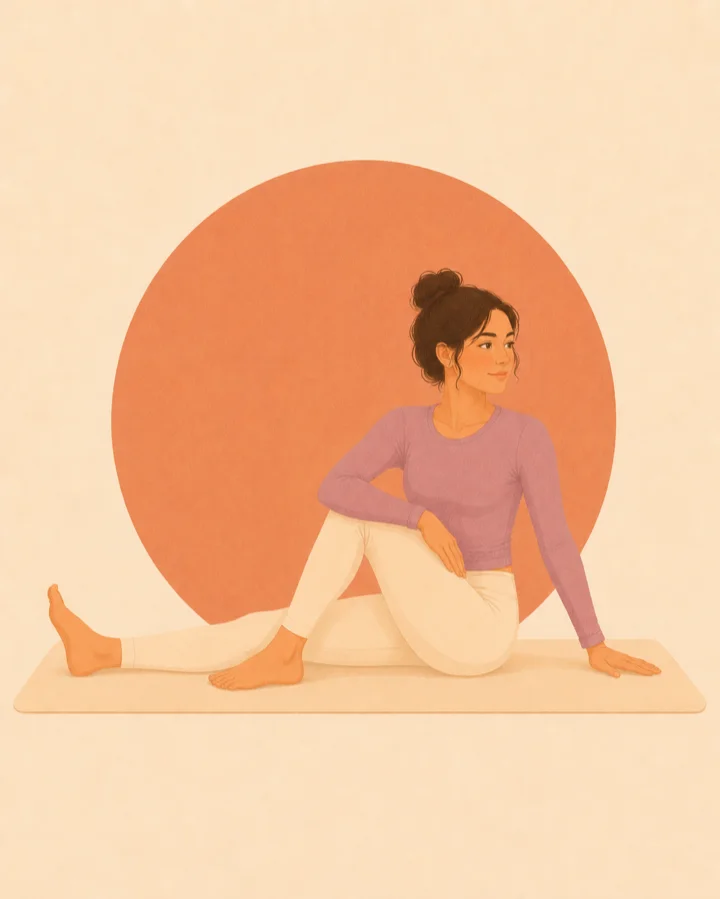
Still on your back, arms out to the sides, let your bent knees fall to one side while your head turns the other way. Stay for 45 seconds on each side, breathing deeply. The twist releases the back muscles and gently relaxes the entire torso.
Exercise 3 — Reclined butterfly (2 min)
On your back, press the soles of your feet together and let your knees open toward the floor. Place one hand on your belly, the other on your chest. Don't try to push your knees down: just let gravity do the work. This position opens the hips and inner thighs, two areas that store a lot of tension.
Exercise 4 — Legs up the wall (2 min)
Sit close to a wall, roll onto your back, and walk your legs up the wall. Arms rest alongside your body. This inverted posture helps venous return and brings an almost immediate feeling of relief to the legs. Ideal if you spend your days standing or sitting.
Exercise 5 — 4-6 breathing (2 min)
Lying comfortably (in your bed is perfect), close your eyes. Inhale for 4 counts, exhale for 6. Nothing else. If thoughts show up, let them pass and come back to your breath. Plenty of people never finish these two minutes: they're asleep before the end.
What if you only have five minutes
Keep exercises 1 and 5: knees to chest, then breathing. What matters isn't the duration but the ritual — that moment when you signal to your body that the day is ending. Five minutes every evening will always do more than thirty minutes once a month.
Evening and morning: two routines that complete each other
The evening routine prepares your sleep; the morning stretching routine wakes your body up for the day. Together they create a virtuous circle: you sleep better, so you recover better, so you move better. And if you're wondering how long it takes to feel real changes, we've broken down realistic timelines for flexibility results.
If you'd like a guided evening routine built around your body, Pliable assesses your mobility in 3 minutes across 8 areas of your body, then gives you a daily routine of less than 10 minutes matched to your level. A gentle way to close out your days, no guesswork required.
Frequently Asked Questions
How long before bed should I do these stretches?
Ideally within 30 to 60 minutes of going to bed, with the lights dimmed and your phone out of reach. That said, the best routine is the one you actually do — even right before slipping under the covers, these slow movements help your body wind down.
Can I do this routine in bed?
Yes, most of these exercises work perfectly well on a mattress. The floor gives better support for the twist and the butterfly, but if bed is the only place where you feel like doing it, go for it. Consistency matters far more than the surface.
Will evening stretches also improve my flexibility?
Yes, as long as you practice regularly. In the evening your body is warm after a full day of movement, which makes stretching more comfortable than in the morning. But the main goal here is relaxation: never push your range of motion right before sleep.
What if I fall asleep during the final breathing exercise?
Nothing at all — that is actually a good sign. This routine is designed to guide your nervous system toward sleep. If you feel yourself drifting off, let it happen: the routine has simply done its job a little earlier than planned.