You know that moment after a meal when your belly seems to have doubled in size. That feeling of tightness, of heaviness, those jeans that suddenly feel too small. Bloating — almost everyone experiences it, and almost no one talks about it.
First, some reassurance: a belly that swells after eating is common. Digestion is demanding background work that uses a lot of energy, and certain meals, a stressful day, or simply eating too fast can slow it down.
The good news is that a few very simple habits can help you feel better: gentle poses, a bit of walking, and calm breathing. Nothing spectacular, nothing demanding — just a moment of kindness for your belly.
Why your belly feels tight
Several mechanisms combine: the air you swallow while eating (especially when eating fast), the gas naturally produced as food ferments, and a digestive system that slows down when you stay still or stressed. Your gut is remarkably sensitive to stress: when you're tense, it shifts into slow mode.
That's where gentle movement comes in. Without any forcing, it helps mobilize the abdominal area, supports your digestion, and sends a calming signal to your nervous system. It's not a medical treatment — it's a kind nudge in the right direction.
Four gentle poses to help your belly
Ideally, wait 30 minutes to an hour after a large meal before doing the floor poses. Settle onto a mat, somewhere quiet.
The gentle seated twist (1 min)
Sitting cross-legged or on a chair, sit up tall, then slowly turn your torso to the right, placing your left hand on your right knee. Never force it: you're looking for a comfortable rotation, not a performance. Breathe deeply for 30 seconds, then switch sides.
Gentle twists softly massage the abdominal area, and many people find them immediately soothing.
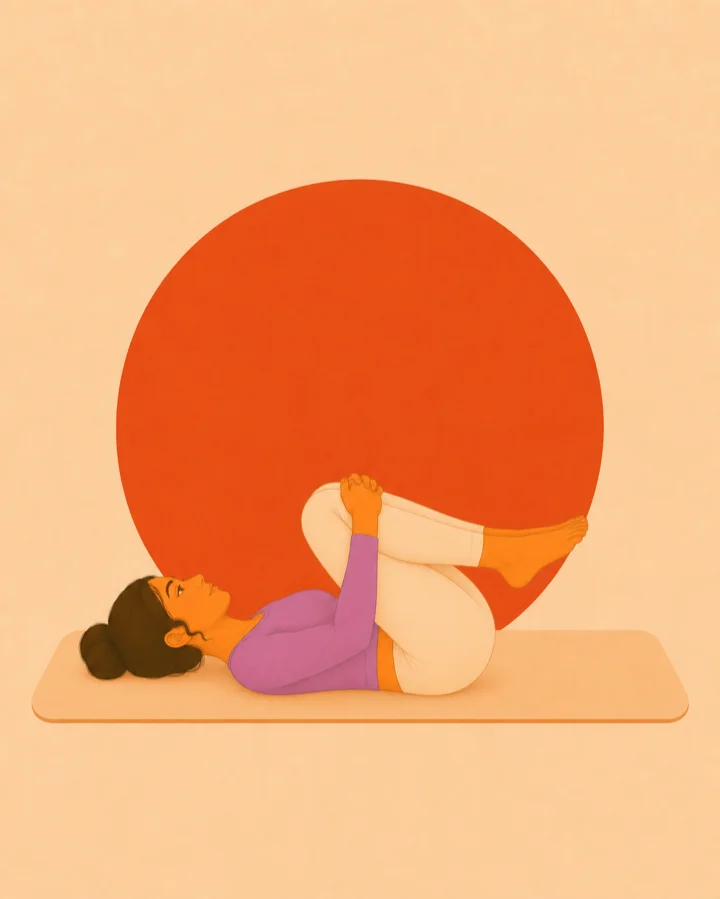
Knees to chest (1 min 30)
Lying on your back, draw both knees toward your chest and wrap your arms around them. Rock gently from side to side. In yoga, this pose has a telling nickname: "wind-relieving pose." Enough said.
Slow cat-cow (1 min 30)
On all fours, alternate very slowly between rounding your back (on the exhale) and arching it (on the inhale). This wave-like movement gently mobilizes the whole belly — and relaxes your back along the way.
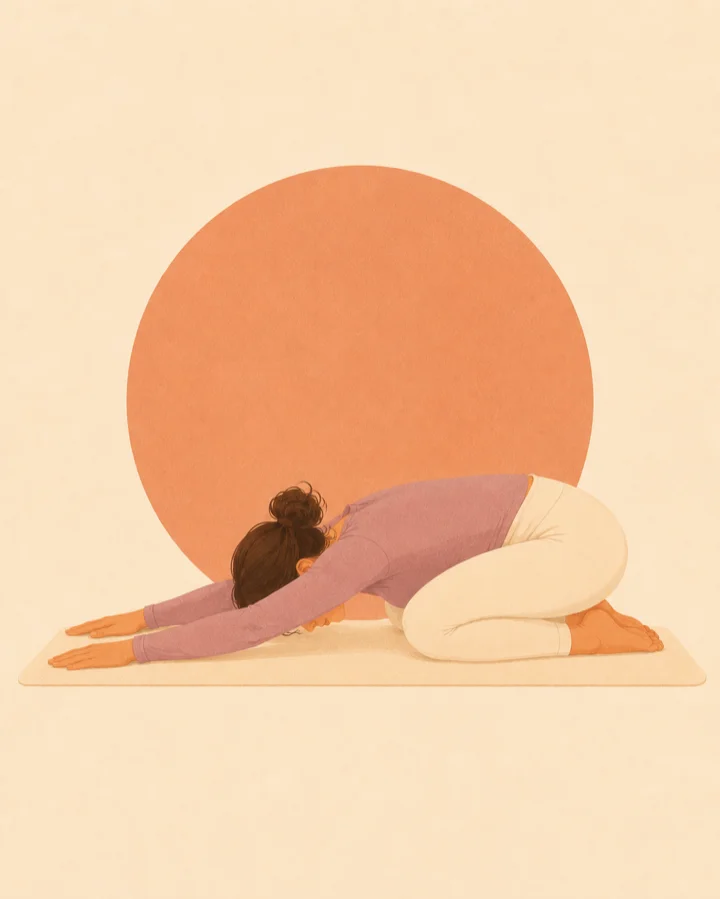
Child's pose with wide knees (2 min)
Kneeling, spread your knees apart, rest your hips on your heels and stretch your torso forward, forehead on the floor or on a cushion. Let your belly settle into the space between your thighs. Breathe slowly. It's the ultimate cocoon pose: it relaxes the belly, the back and the mind all at once.
The digestive walk: simple and underrated
This might be the most effective habit in this whole article: 10 to 15 minutes of easy walking after a meal. Not power walking, not exercise — just a stroll.
Walking gently supports your digestion through the body's natural movement, and it keeps you away from that slumped-on-the-couch position that compresses your belly. If you only remember one thing from this article, make it this one.
Belly breathing (3 min)
The diaphragm, that muscle sitting under your lungs, acts a bit like an internal massage for your belly with every deep breath.
Sit comfortably or lie down. Place one hand on your belly. Inhale through your nose, letting your belly rise gently under your hand (4 seconds), then exhale slowly through your mouth (6 seconds), letting the belly fall. Continue for 3 minutes.
Beyond the mechanical effect, this kind of breathing activates your parasympathetic nervous system — your body's "rest and digest" mode. Exactly the mode your digestion needs.
The little habits that change everything
Eat more slowly. A large part of the air responsible for bloating is swallowed when eating fast.
Avoid lying down right after a meal. Stay upright or semi-reclined for at least an hour.
Loosen anything that compresses. A tight belt or waistband really doesn't help your belly do its job.
And one important note: if your bloating is daily, painful or accompanied by other symptoms, talk to a doctor. These poses are comfort support, not treatment.
If you enjoy these gentle moments, you can turn them into a daily ritual: our morning stretching routine is built in exactly the same spirit. And for guided routines of under 10 minutes, tailored to your body, Pliable is there day after day — starting with a mobility score measured in just 3 minutes.
Frequently Asked Questions
How long after a meal can I do these poses?
For floor poses like the twist or knees-to-chest, ideally wait 30 minutes to 1 hour after a large meal. The digestive walk and belly breathing, on the other hand, can be done right after eating.
Do twists really help digestion?
Gentle twists mobilize the abdominal area, and many people find them soothing when the belly feels tight. They are no substitute for medical treatment, but combined with a light walk and calm breathing, they can contribute to your digestive comfort.
What if I feel bloated every single day?
Occasional bloating is common, but if it is daily, painful or accompanied by other symptoms, talk to a doctor. These poses are a wellness support, not a diagnosis or a treatment.