"Touch my toes? Not a chance. I have always been stiff as a board — that is just how I am." If that sentence could have come out of your mouth, this article was written for you.
Because here is the truth: barring a specific medical condition, there is no such thing as a body that is "too stiff to improve." There are hamstrings that have not moved in that direction for years, and a brain that has learned to limit the movement out of caution.
The good news? All of it can be retrained. Not in a week, and not by forcing — but through a gentle, consistent progression. Here is the path, step by step.
The myth of the hopelessly stiff body
We love labeling ourselves: "flexible" or "stiff," as if it were written into our genes once and for all. In reality, flexibility is a capacity that can be maintained and developed at any age.
What limits your forward fold is usually not the "length" of your muscles. It is mostly your nervous system doing its job as a gatekeeper: when you approach a range of motion it does not recognize, it triggers protective tension to stop you. Your body is not refusing the movement — it just does not trust it yet.
The implication is genuinely encouraging: by regularly showing your nervous system comfortable ranges of motion, you teach it that the territory is safe. And it releases the brake, week after week.
Why your hamstrings feel locked up
Your hamstrings are the muscles at the back of your thighs. They connect your pelvis to your knees and play a central role in any forward fold. When you spend your days sitting, they stay in a shortened position for hours — and your brain eventually treats that position as the norm.
Add the stretch reflex — the automatic contraction that fires when a muscle is stretched too fast or too hard — and you understand why "pulling harder" never works. The more you force, the more your body resists.
The step-by-step progression
Four stages. Move on to the next one only when the current one feels comfortable. Plan on five minutes a day, ideally when your body is a little warm — at the end of the day, after a walk, or after a shower.
Stage 1 — Standing fold with bent knees (weeks 1 and 2)
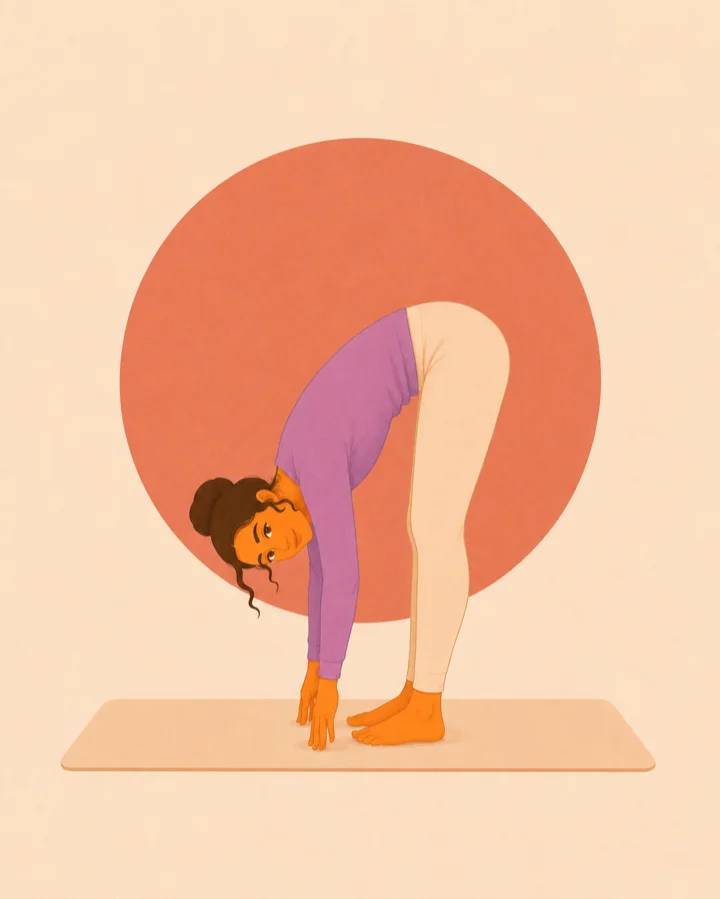
Standing with feet hip-width apart, bend your knees generously and let your torso rest on your thighs. Hold your calves or ankles if you can reach them. Yes, bending your knees is allowed — it is actually the whole point of this stage. The goal is not straight legs; it is teaching your pelvis to tilt forward without stress.
Stay for 30 seconds while breathing deeply, come up slowly, and repeat 3 times.
Stage 2 — Seated forward fold with support (weeks 3 and 4)
Sit on the floor with your legs in front of you, knees slightly bent. Loop a towel or a strap under the soles of your feet and hold both ends. Keep your back long: imagine bringing your belly button toward your thighs, not your forehead toward your knees.
Do 3 sets of 45 seconds. On each exhale, let your torso drift forward by a millimeter — no more.
Stage 3 — Straightening the legs, millimeter by millimeter (weeks 5 to 8)
Same seated position, but you gradually reduce the bend in your knees, session after session. The sensation should remain a clear but comfortable stretch at the back of your thighs. If you feel pulling behind the knee, back off immediately — that is the sign you have gone too far.
Do 3 sets of 45 seconds to 1 minute, every day or close to it.
Stage 4 — Back to standing
Once the seated version feels comfortable with straight legs, return to the standing fold. Knees barely bent, let gravity draw your torso down. Measure your progress once a week: the distance between your fingertips and the floor is your best indicator. Do not test every day — change shows up over weeks, not days.
The golden rules for progressing safely
Never bounce. Those little pulses to "gain" a few centimeters trigger the stretch reflex and tighten the muscle. The exact opposite of what you want.
Your exhale is your ally. It is during the slow exhale that your nervous system releases tension. Breathe in through your nose, breathe out long through your mouth.
Five minutes a day beats an hour on Sunday. Consistency is the only truly non-negotiable ingredient. For a realistic idea of timelines, we broke down how long it takes to get more flexible — spoiler: less time than you fear, as long as you practice often.
No pain, ever. A clear but pleasant tension, yes. Anything that stings or burns, no.
In a nutshell
Touching your toes is neither a gift nor a feat: it is the result of a patient conversation with your nervous system. Bent knees first, a strap next, straight legs last — and above all, a little bit every day.
If you want to know where you are starting from, Pliable measures your mobility score in 3 minutes, hamstrings included, then builds routines of under 10 minutes matched to your level. You just show up — the progression takes care of the rest.
Frequently Asked Questions
Is it a problem if I cannot touch my toes?
Not in itself. Plenty of perfectly healthy people cannot do it. It is, however, a useful indicator: very tight hamstrings can pull on your pelvis and increase tension in your lower back. Working on this area gently brings real everyday comfort.
Is bending your knees during a stretch cheating?
Not at all — it is actually recommended. Bending your knees lets your pelvis tilt properly and targets the hamstrings without overloading your lower back. Over the weeks, you will straighten your legs gradually. The quality of the movement matters far more than how it looks.
How long does it take to touch your toes?
It depends on your starting point, but with five minutes of daily practice, most people notice clear progress within 4 to 8 weeks, and many reach their toes within 2 to 3 months. Consistency matters infinitely more than the intensity of any single session.
Why do I feel pain behind my knee when I stretch?
A sharp sensation behind the knee often means you are pulling too hard or too far, sometimes on sensitive nerve structures. Reduce the range, bend your knees slightly, and stay within a comfortable tension. If the pain persists despite these adjustments, see a health professional.