End of the day. You notice your shoulders have crept up almost to your ears, your jaw has been clenched for hours, your neck feels set in concrete. Nobody asked you to carry anything — and yet you've been carrying your entire day in your muscles.
Stress isn't just a mental experience. It's also — perhaps above all — a physical one. Your body reacts to every urgent email, every deadline, every tense conversation with muscle contractions you're not even aware of.
The good news? This mind-body link works in both directions. If stress tightens your muscles, releasing your muscles calms your stress. Here's where your body stores tension, and how to let it go.
What stress does to your muscles
Faced with a threat, your body triggers an ancient response: fight-or-flight mode. Your heart rate speeds up, your breathing gets shallow, and your muscles contract to protect vital areas and prepare for action.
The problem is that your body can't tell the difference between physical danger and an overflowing inbox. So this response fires dozens of times a day, without ever leading to the movement it's preparing for. The muscles contract… and stay contracted.
Over time, these permanent contractions become chronic tension: muscle knots, stiffness, headaches, fatigue.
Stress's three favorite hiding spots
The neck and traps
This is ground zero. Under stress, the shoulders rise and the head juts forward — an instinctive protective posture. The trapezius muscles, that diamond-shaped sheet between your neck and shoulders, end up working non-stop, like an engine that never switches off.
The jaw
The most discreet one. Clenching your teeth is such an automatic stress response that it has its own names: daytime clenching and nighttime bruxism. The telltale signs: sore temples, sensitive teeth, a jaw that feels tired when you wake up.
The shoulders and upper back
The hunched stress posture — shoulders rolled forward, chest closed — shortens the chest muscles and overworks the upper back. If you work at a screen, this stress posture stacks on top of your desk posture. A double burden, which we cover in detail in our guide to back pain at the office.
Four exercises to release (at your desk or at home)
1 — Neck half-circles (1 min 30)
Sitting tall, let your chin drop toward your chest. Slowly roll your head toward your right shoulder, back to center, then toward the left. Stick to forward half-circles — no full rolls toward the back. Do 6 to 8 very slow passes, letting the weight of your head do the work.
2 — Shoulder raise and drop (1 min)
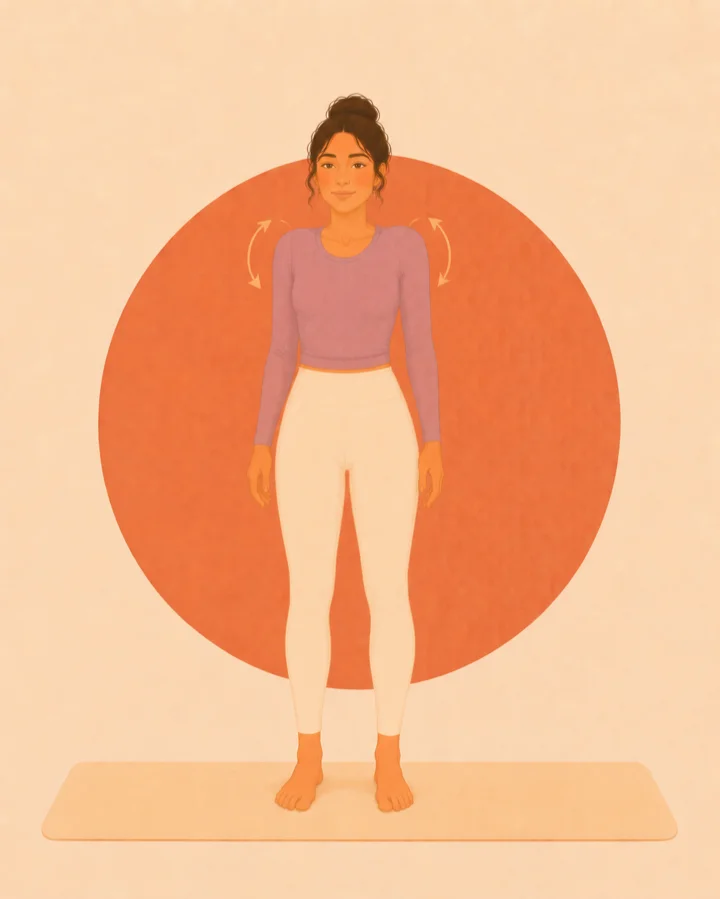
Inhale while raising your shoulders toward your ears, as high as you can. Hold for 5 seconds, squeezing hard. Then exhale through your mouth and let your shoulders drop all at once. Repeat 5 times. This contrast between contraction and release re-teaches your traps the way back to rest mode.
3 — Jaw release (1 min)
Place the tip of your tongue against the roof of your mouth, just behind your upper teeth: this mechanically prevents clenching. Then gently massage your masseters — the muscles you feel bulge when you clench your teeth — with your fingertips, in small circles, for 30 seconds on each side.
4 — The express body scan (2 min)
Sitting or lying down, close your eyes. Mentally sweep through each area from your forehead down to your feet, and with each exhale, consciously release that area: the forehead smooths out, the jaw unclenches, the shoulders drop. It's a skill: the more you practice, the earlier in the day you'll catch tension building.
Breathing: your built-in off switch
If you only remember one tool, make it this one. A slow exhale is one of the few direct, voluntary ways to reach your parasympathetic nervous system — the one in charge of calm and recovery.
The technique: inhale through your nose for 4 counts, exhale through your mouth for 6 to 8 counts, as if blowing through a straw. Three minutes is enough to feel your shoulders come back down. Use it before a tense meeting, after a difficult call, or in the evening to set the day down.
Prevent instead of endure
Tension builds up in silence. The most effective countermeasure isn't one big weekly session, but regular micro-breaks: every hour, 30 seconds to roll your shoulders, unclench your jaw, and breathe deeply. Your body registers every calming signal.
To help you make it a reflex, Pliable offers routines of under 10 minutes a day, designed to release the neck and shoulders too — and its 3-minute mobility score shows you where your body needs gentleness the most.
Frequently Asked Questions
Why does stress settle in the neck and shoulders?
When facing stress, your body prepares to react: the shoulders rise, the neck stiffens, the jaw clenches. It is a very old protective reflex. When stress becomes chronic, these muscles stay contracted around the clock and eventually create painful tension.
How do I know if I clench my jaw without realizing it?
A few clues: tension when you wake up, headaches near the temples, sensitive teeth, or tired cheek muscles. Check in with yourself several times a day: if your teeth are touching when you are not eating, your jaw is probably clenched.
Can breathing really reduce muscle tension?
Yes. A slow, extended exhale activates the parasympathetic nervous system, the one in charge of rest and recovery. It is one of the few direct levers you have to signal to your body that it can stand down.
What if the tension persists despite the exercises?
If the pain lasts several weeks, intensifies, or comes with frequent headaches, see a healthcare professional. Release exercises are excellent daily support, but they do not replace medical advice.