"Sit up straight!" You've heard it a hundred times. And a hundred times, you've held the position… for about thirty seconds, before your shoulders rolled forward again, as if magnetized by your keyboard.
First thing to know: this is neither a lack of willpower nor a character flaw. Rounded shoulders are your body's perfectly logical adaptation to what you ask of it every day — hours in front of a screen, arms reaching forward.
Second thing to know: it can be worked on. Not by forcing yourself to "stand properly," but by giving your body back the abilities it rarely uses: opening the chest, mobilizing the upper back, waking up the muscles between your shoulder blades. Gently, a few minutes a day.
Why your shoulders roll forward
Your body is a remarkable adaptation machine. When you spend hours with your arms out in front of you, it optimizes: the chest muscles (the pecs) shorten, the mid-back muscles — asked to do less — lose tone, and the upper part of your spine (the thoracic area) gradually settles into a slight forward curve.
The result: the rounded position becomes the resting position. It's not a malfunction, it's a specialization. Your body has simply become very good at the posture you ask of it most often.
Let's stop talking about "bad posture"
One important point before the exercises: modern research paints a much more nuanced picture of the direct link between posture and pain. There is no single perfect posture, and holding a "correct position" rigidly for eight hours a day is not the answer — that would just be another form of immobility.
The real problem is not your position, it's the lack of variety. The best posture is always the next one. So the goal of this article is not to turn you into a soldier at attention, but to give your body back the choice: being able to open up easily whenever it needs to.
The exercises to open your chest and shoulders
Four movements, about ten minutes. Do them in one quiet session or spread them through your day.
1 — Doorway chest opener (2 min)
Place your forearms on either side of a doorframe, elbows at shoulder height. Step half a step forward until you feel a pleasant stretch across your chest. Breathe calmly for 30 seconds, release, then repeat. This is the most direct stretch for shortened pecs — and you walk past doorways all day long.
2 — Wall W (2 min)
Back against a wall, feet slightly forward. Press your lower back, the back of your head, and your elbows into the wall, arms bent in a "W" shape. Slowly slide your arms upward toward a "Y", then back down, keeping your elbows in contact with the wall. Do 8 to 10 slow repetitions. This exercise strengthens exactly the muscles that draw your shoulder blades back.
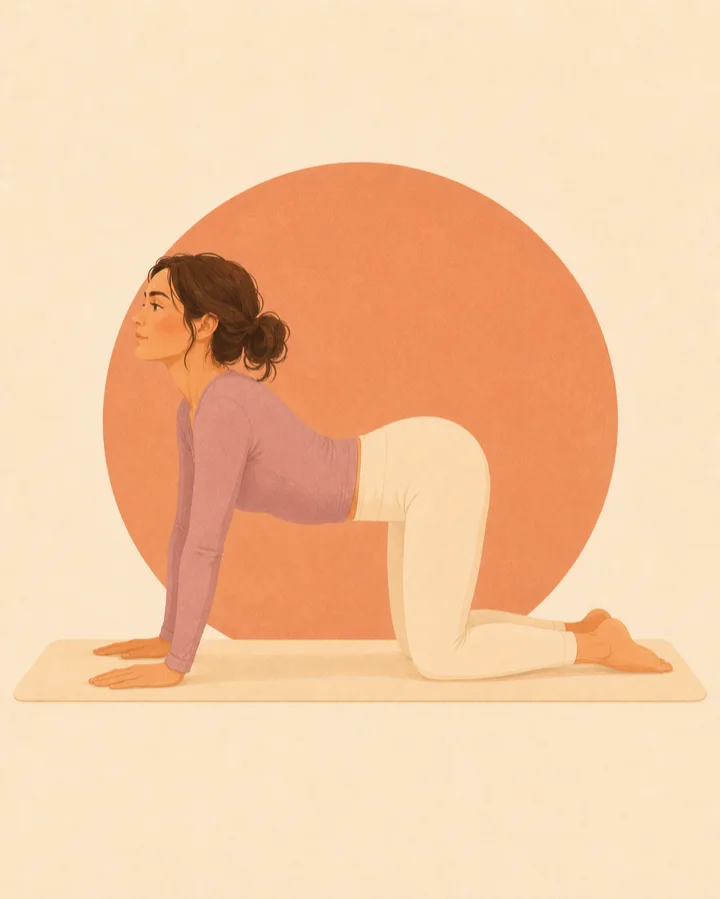
3 — Thoracic rotation on all fours (2 min)
On all fours, place your right hand behind your head. On the exhale, bring your right elbow toward your left arm; on the inhale, open it toward the ceiling, letting your gaze follow the movement. Do 6 to 8 rotations per side. The upper back is the hidden key to rounded shoulders: when it regains its mobility, the shoulders follow naturally.
4 — Lying chest opener (2 to 3 min)
Roll up a bath towel lengthwise and lie down on it, the towel running along your spine, head supported. Open your arms out to the sides or into a "cactus" shape, palms up, and breathe. Gravity does the opening work for you. Perfect in the evening, with a podcast on.
At the office: think "variety," not "perfect position"
Rather than policing your posture all day (exhausting and ineffective), build in opportunities to move:
A micro-opener every 45 to 60 minutes. Stand up, interlace your fingers behind your back, open your chest for 20 seconds. That's it.
A screen at eye level. Not to achieve perfection, but to keep your head from diving forward for hours on end.
Positions that change. Sitting, standing, leaning, walking during a call: every change is a breath of fresh air for your shoulders. To go further, our article on back pain at the office pairs perfectly with this one.
What you can expect
From the very first sessions, you'll notice fuller breathing and a chest that feels less closed — openness is something you feel right away. For a lasting change in your natural resting position, count on a few weeks of consistency. And remember: the goal is to feel better in your body, not to win a posture contest.
If you want to know where your shoulders really stand, Pliable measures your mobility in 3 minutes across 8 areas of the body — shoulders and back included — then builds you daily routines of less than 10 minutes to open everything back up, gently and guilt-free.
Frequently Asked Questions
Are rounded shoulders permanent?
No, in the vast majority of cases they are not. Shoulders roll forward because certain muscles have adapted to your most frequent position. By working on chest opening and upper back mobility a few minutes a day, that adaptation runs in the other direction.
Is a posture corrector a good idea?
It can serve as an occasional reminder, but it does not strengthen your muscles and may even make them passive if worn all the time. Regular movement remains the better option: your body learns to hold its posture on its own, no accessory needed.
How long until I see a difference?
The first sensations come quickly: easier breathing and a more open chest from the very first sessions. For a visible, lasting change, plan on several weeks of regular practice, a few minutes per day.
Can strength training help with rounded shoulders?
Yes, as a complement. Rows and exercises that strengthen the mid-back balance out the pull of the chest muscles. The ideal combination: strengthening, upper back mobility, and regular breaks away from the screen.