You lace up your shoes, pull on each calf against a wall for thirty seconds, and off you go. Or maybe you do nothing at all — after all, running is already exercise, right?
Most recreational runners treat mobility as optional. Then come the tight calves, the hips that lock up, that knee that "talks" on the downhills. Running is a wonderful but repetitive movement: several thousand strides per outing, always in the same plane. Without a minimum of maintenance, the body specializes… and stiffens.
The good news: you don't need to spend hours on it. Five minutes before, five minutes after. Here's exactly what to do.
Before the run: wake up, don't stretch out
Long static stretches before effort are not your friends: held too long, they can temporarily reduce muscle tone, and they don't prepare your joints for movement. What your body wants before a run is progressive movement that builds heat. If the difference between stretching and mobilizing intrigues you, we break it down in stretching vs mobility.
1 — Leg swings (1 min 30)
Steady yourself against a wall or a tree. Swing one leg forward and back, 12 to 15 times, letting the range grow naturally. Then swing it sideways in front of you, 12 to 15 times. Switch legs. Your hips wake up in both planes of movement.
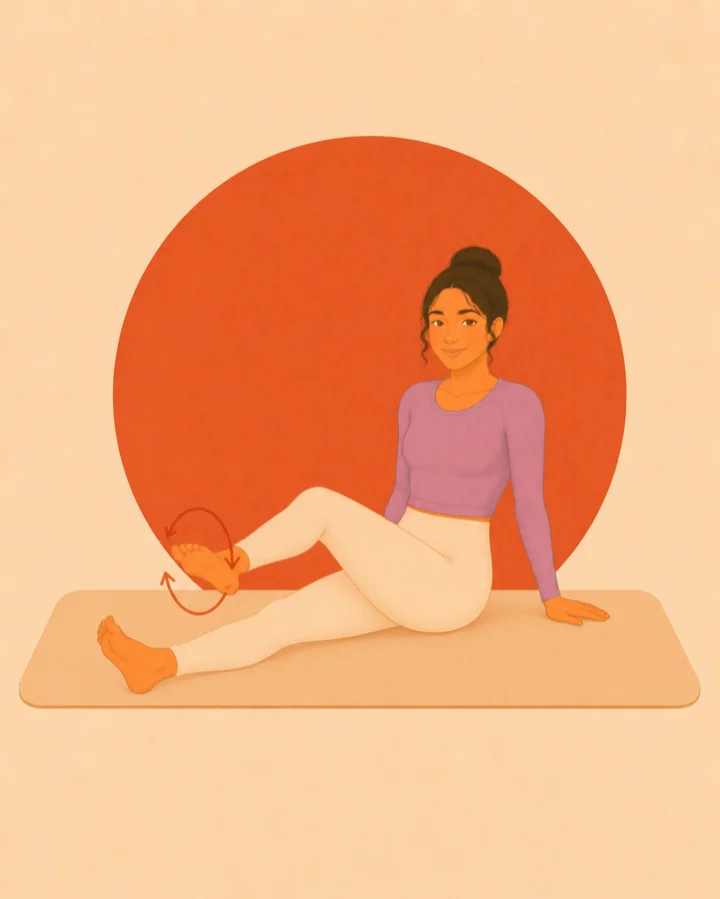
2 — Ankle circles and calf raises (1 min)
Do 10 ankle circles in each direction, per foot, then follow with 15 brisk calf raises. Your ankles absorb several times your body weight with every stride — they deserve 60 seconds of attention.
3 — Walking lunges with rotation (1 min 30)
Do 8 to 10 walking lunges, gently rotating your torso toward the front leg with each lunge. This movement opens the hips, fires up the glutes, and wakes the spine — three for one.
4 — High knees and butt kicks (1 min)
Finish with 30 seconds of high knees, then 30 seconds of butt kicks, in place or moving forward, gradually picking up the rhythm. The perfect transition into your first strides.
After the run: time for gentleness
After a run, your body is warm: the ideal moment for gentle mobility and held stretches. Always stay within a comfortable sensation — the goal is to recover, not to grimace.
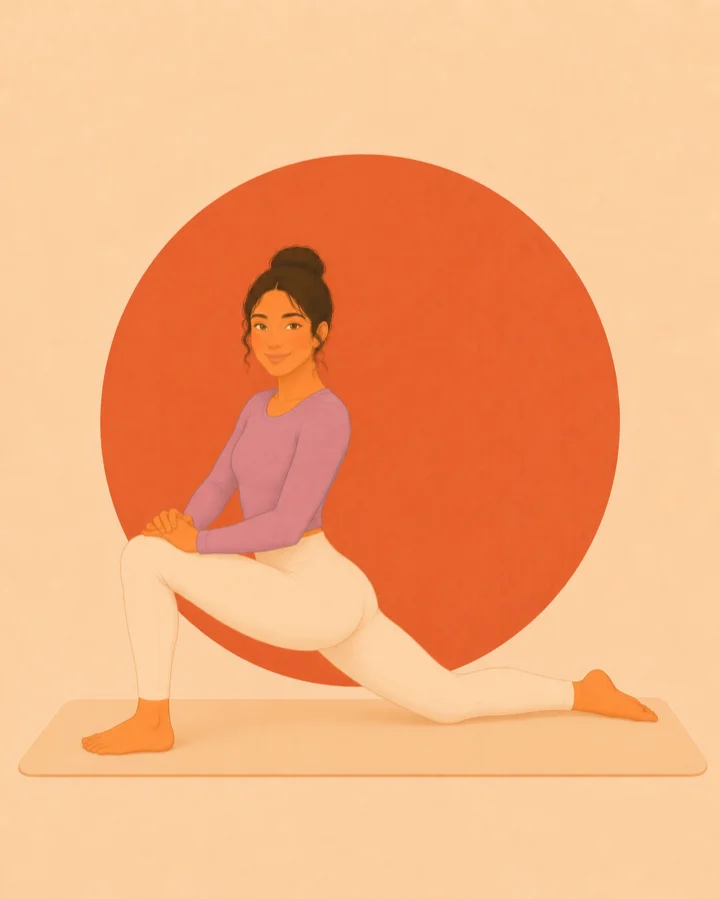
1 — Runner's lunge (2 min)
Back knee on the ground, front foot well ahead, let your pelvis sink gently forward with your torso upright. You're stretching the hip flexors, heavily recruited by every stride. Hold for 45 seconds on each side. Enhanced version: raise the arm on the side of the grounded knee and lean slightly toward the opposite side.
2 — Calf stretch (1 min 30)
Hands against a wall, back leg straight, heel on the ground: hold for 30 seconds. Then bend the back knee slightly, heel still down, for another 30 seconds to reach the soleus, the deep calf muscle. Switch legs.
3 — Reclined figure 4 (2 min)
On your back, place your right ankle on your left knee, then grab the back of your left thigh and draw it gently toward you. You'll feel the stretch deep in the glute — an area runners know well. One minute per side.
4 — Standing quad stretch (1 min)
Standing, catch your ankle behind you, knees close together, glute lightly engaged to avoid arching. Hold for 30 seconds per leg, using a support for balance if needed.
Hips and ankles: a runner's two priorities
A smooth stride depends above all on two areas. Hips that extend well, so you can push off behind you without compensating through the lower back. And ankles that flex well, to absorb and return energy with every footstrike. If you have to prioritize your mobility work, start there — our guide to hip mobility will give you a solid foundation.
The classic mistakes
Long static stretching on cold muscles before a run. As we've seen: before effort, your body wants dynamic, not static.
Betting everything on run day. Mobility progresses through small, regular doses. Ten minutes spread across the week will always beat one big monthly session.
Confusing pain with effectiveness. After a long run, your body needs gentleness. A stretch that makes you wince doesn't speed up recovery — it delays it.
Curious where you stand? The Pliable mobility score assesses 8 areas of your body in 3 minutes — hips and ankles included — then the app builds you routines of less than 10 minutes, easy to slot in between runs.
Frequently Asked Questions
Should I stretch before running?
Not with long static stretches: held for more than 45 seconds, they can temporarily reduce muscle tone. Before a run, favor a dynamic warm-up — leg swings, lunges, high knees — that prepares the joints without switching the muscles off.
Does stretching prevent running injuries?
The research is nuanced: stretching alone has no proven miracle effect. Training progression, sleep, and recovery matter at least as much. Good hip and ankle mobility mainly improves the quality of your stride, which remains an excellent investment.
How much time should runners spend on mobility?
Five minutes before each run, five minutes after: that base alone already makes a real difference. If you want to go further, add one or two short mobility sessions on non-running days, focusing on hips and ankles.
What about days when I do not run?
Rest days are perfect for gentle mobility: your body is fresh, with no workout fatigue. Ten minutes on the hips, ankles, and back maintains your range of motion and sets up your next run.