There's a muscle you use with every step, every flight of stairs, every time you sit up in bed. A muscle so deep you can't touch it, so discreet you almost never feel it working. And yet it directly shapes your back, your hips, and the way you move.
That muscle is the psoas. And if you spend your days sitting, it's probably getting shorter — quietly, without warning.
Don't panic: nothing about this is irreversible. But understanding what's happening at the front of your hips is one of the most underrated keys to a happy back.
What exactly is the psoas?
The psoas is a long, deep muscle that runs from your lumbar vertebrae to the inside of your thigh bone, crossing through the pelvis. Together with its neighbor the iliacus, it forms what we call the hip flexor: the muscle that draws your thigh toward your torso whenever you walk, run, or climb a step.
What makes it special: it's the only muscle that directly connects your upper and lower body. One end anchored to your spine, the other to your leg. This anatomical bridge explains why a tight psoas can make itself felt… in your lower back, even though the problem starts at the hip.
What hours of sitting do to it
When you sit, your hips are flexed at roughly 90 degrees. In that position, the psoas is shortened — not contracted, just held short. One hour is nothing. But seven to eight hours a day, year after year, and your body takes note: it adapts the resting length of the muscle and the tissues around it.
The trouble shows up when you stand. A psoas that has become too short never quite regains its full length: it pulls on your lumbar vertebrae, forward and down. Your lower back arches more, the pressure on it increases, and your glutes — the psoas's great opposites — find it harder and harder to do their job.
All of this happens in silence. The psoas itself almost never hurts. Its neighbors send the bill instead: a tired lower back, stiff hips, a stride that keeps getting shorter.
The signs of a psoas that lacks length
A few common clues, to observe without self-diagnosing:
- Stiffness at the front of the hip when you stand up after a long stretch of sitting, with that need to "unrust" for the first few seconds.
- A lower back that tires when you stand for a long time.
- Difficulty taking a big step backward without your pelvis tipping or your back arching.
- A blocked feeling at the hip at the end of your stride when you walk fast.
If several of these ring a bell, the exercises below should do you a lot of good.
The exercises to give it back some space
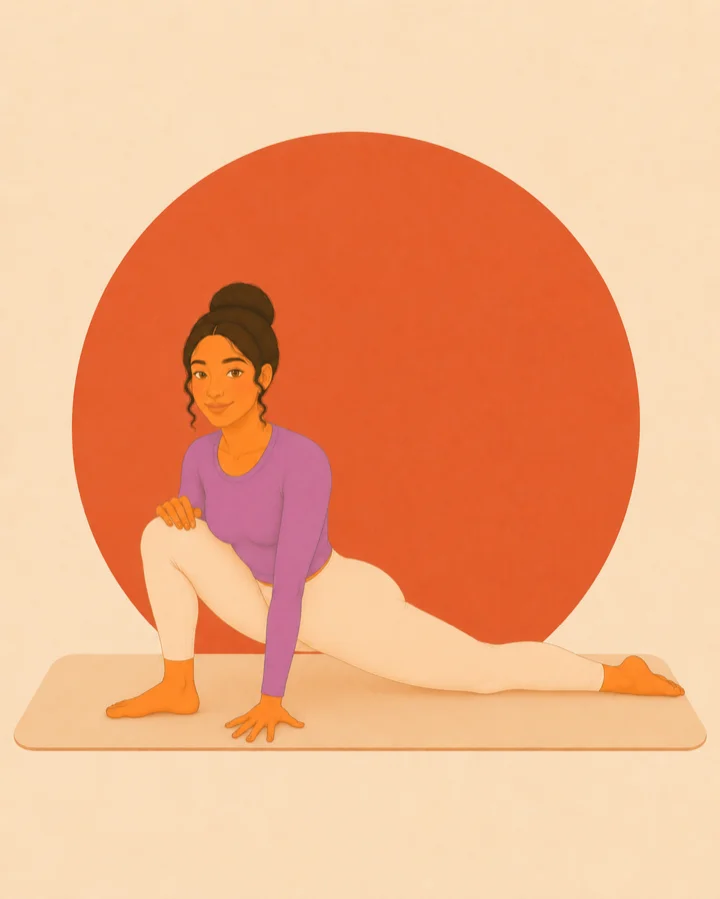
1 — The low lunge (2 min)
Place one knee on the floor, the other foot well in front of you. Before you move, adjust your pelvis: imagine drawing your pubic bone toward your belly button, as if erasing the arch in your lower back. Then let your weight glide gently forward, torso upright. You should feel a clear but comfortable stretch at the front of the back hip. Hold for 45 seconds on each side.
The detail that changes everything: keep the pelvis tucked. Without it, your back arches and the stretch misses its target.
2 — The glute bridge (2 min)
Lying on your back, knees bent, feet on the floor. Lift your pelvis by squeezing your glutes, hold for 2 seconds at the top, come down slowly. Do 10 to 12 repetitions. Hip extension is the exact opposite of the seated position — and awake glutes take daily pressure off the psoas.
3 — The standing stretch (1 min 30)
Standing in a slight lunge, back leg straight. Squeeze the glute of the back leg and gently push that hip forward. To intensify, reach the same-side arm toward the ceiling. Hold for 30 to 45 seconds per side. Perfect at the office — no need to get on the floor.
The bonus that costs nothing
Stand up every 45 to 60 minutes, even for just 30 seconds. A psoas that regularly changes position has no reason to set in place. It's the simplest, highest-return habit on this list.
The psoas never acts alone
Your psoas is part of an ecosystem: hips, glutes, lower back — everything is connected. For a complete approach to the area, our beginner's guide to hip mobility is the ideal companion to this article. And if you want to anchor the psoas stretch into your daily life, it already has its place in our morning stretching routine.
Curious about where your hips really stand? The Pliable mobility score assesses 8 areas of your body in 3 minutes, then the app builds daily routines of less than 10 minutes, targeted at what needs it most — psoas included.
Frequently Asked Questions
How do I know if my psoas is too tight?
A few clues: stiffness at the front of the hip when you stand up after sitting for a long time, a lower back that tires when you stand for extended periods, or difficulty taking a big step backward without arching. These are not absolute proof, but they are signals worth answering with regular stretching.
Can the psoas cause lower back pain?
A shortened psoas can contribute to it: since it attaches to the lumbar vertebrae, it can increase the arch and the pressure on the lower back. It is never the only possible explanation: if the pain persists or worries you, see a healthcare professional.
Should I massage my psoas myself?
The psoas is a very deep muscle, sitting behind the organs: self-massage is difficult and rarely pleasant. Stretching, regular movement, and glute strengthening are more effective and safer. For hands-on work, turn to a trained professional.
How long does it take to restore length to the psoas?
With a daily stretch and regular standing breaks, most people feel a difference within two to four weeks: less stiffness when getting up from a chair and a freer stride. The key is consistency, not intensity.