"If I cannot do a proper workout, there is no point." That little sentence has probably killed more good intentions than lack of motivation ever did.
We imagine we need to sweat for an hour to deserve results. So we wait for the day we will have the time — and that day never comes. Meanwhile, the body quietly stiffens.
Here is the truth that habit science has been repeating for years: when it comes to mobility, four minutes a day beats one big weekly session. Here is why — with a concrete routine to go with it.
What the science of small habits says
Researchers who study habit formation are clear: what turns an action into an automatism is not its intensity, it is repetition in a stable context. Same time, same place, same trigger — that is what etches a habit into the brain.
And the shorter and easier an action is, the more repeatable it becomes. A four-minute routine requires almost no motivation, no slot in the calendar, no negotiation with yourself. It flies right under the radar of procrastination.
Then something interesting happens: every small win reinforces the identity of someone who moves every day. That identity shift — "I am a person who takes care of their body" — is the foundation of habits that last for years.
Consistency versus intensity: no contest
For mobility specifically, frequency has a direct physiological advantage. Your range of motion is largely regulated by your nervous system, and your nervous system learns through repetition, exactly like learning a musical instrument.
Four minutes a day means seven exposures to movement per week. A 30-minute session on Sunday means just one. The first scenario tells your body: "these ranges are needed every day, keep them available." The second remains an isolated event, quickly erased by six days of stillness.
This is exactly what we see in progress timelines: consistency is the number one factor, far ahead of session length. We broke down the numbers in our article on how long it takes to see flexibility results.
Minimal friction, your secret weapon
The other superpower of micro-routines is the absence of friction. Think about everything a "real" workout demands: changing clothes, rolling out a mat, finding 45 minutes, showering afterward. Every step is an opportunity to bail.
A four-minute routine demands nothing: no outfit, no equipment, no shower. You can do it in your pajamas between your bed and the bathroom. When the barrier to entry is that low, excuses have nothing to grab onto.
That is the principle worth remembering: make the good behavior so easy that doing it becomes simpler than avoiding it.
Your 4-minute routine, stopwatch in hand
One movement per minute, no complicated transitions. Do it at any point in your day.
Minute 1 — Cat-cow
On all fours, slowly alternate between rounding your back on the exhale and arching it on the inhale. About 8 reps to wake up your entire spine.
Minute 2 — Alternating low lunge
One foot forward, back knee on the floor, hips drifting gently forward. 30 seconds per side to open the front of your hips — the area that sitting punishes most.
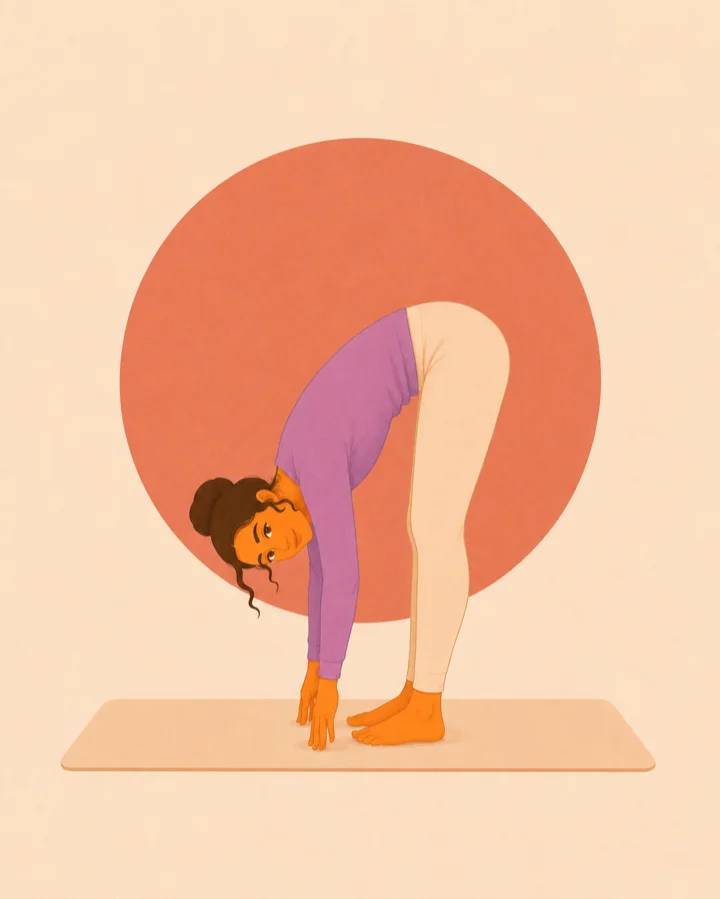
Minute 3 — Standing forward fold
Standing with soft knees, let your torso fall forward and your arms hang. Breathe deeply, then roll back up one vertebra at a time. Your entire posterior chain will thank you.
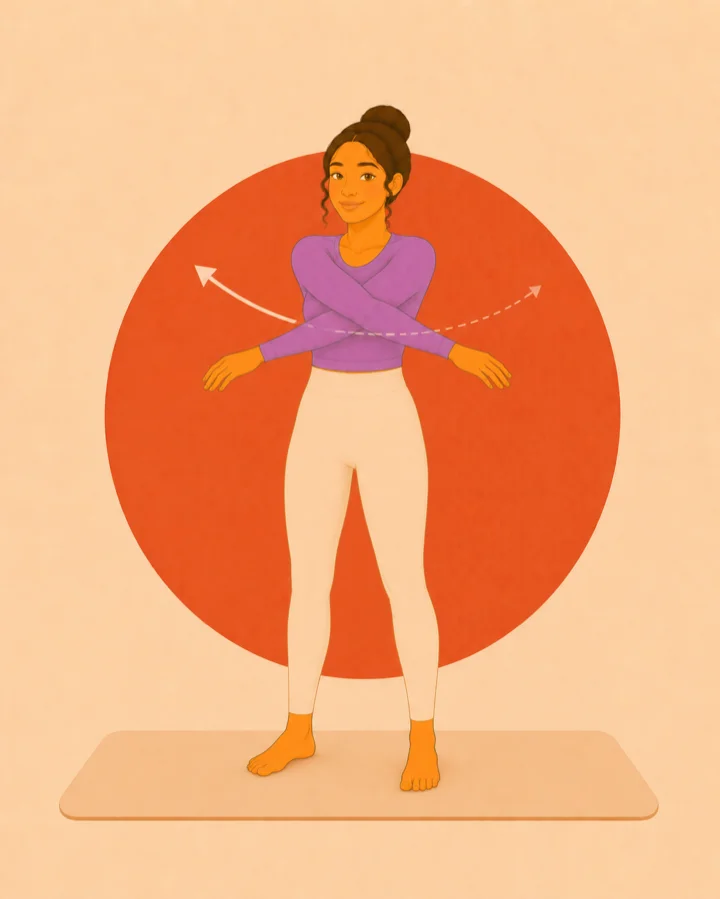
Minute 4 — Chest opener
Standing, interlace your fingers behind your back, extend your arms and open your chest while drawing your shoulder blades together. 30 seconds, twice. The perfect antidote to rounded shoulders.
Making your micro-routine stick for good
Three rules are all it takes.
Attach it to an existing habit. Right after brushing your teeth, right before your shower, right after closing your laptop. The trigger does all the remembering for you.
Never miss two days in a row. Missing one day happens. Missing two is the start of a new habit — the habit of not doing it.
Let the routine grow on its own. After a few weeks, you will often feel like continuing past the four minutes. That is the perfect moment to move up to a 10-minute morning routine — but only when the desire is there.
In a nutshell
Four minutes is not a discount version of a real session. It is the smartest strategy for building a practice that lasts: minimal friction, daily repetition, and a nervous system that learns a little more every day.
That is exactly the philosophy behind Pliable: a mobility score measured in 3 minutes, then made-to-measure routines of under 10 minutes a day. No heroics, just consistency — the kind that always wins in the end.
Frequently Asked Questions
Can 4 minutes a day really produce results?
Yes, as long as you keep it up over time. For mobility, the frequency of the stimulus matters more than its duration: four daily minutes expose your body to movement seven times a week, which is enough to maintain and improve your range of motion over the weeks.
Is 4 minutes a day better than 30 minutes on the weekend?
For flexibility and mobility, 4 minutes a day almost always wins. Your nervous system learns through repetition: a short but daily stimulus is more effective than one long isolated session, and above all much easier to sustain for months.
What is the best time of day for a micro-routine?
The best time is the one you can stick to every day. Right after waking up and just before bed both work very well, because they attach to habits that already exist. Pick a slot, keep it for two weeks, and it will become automatic.
What should I do when I miss a day?
Nothing special: simply pick it up again the next day, without guilt and without trying to catch up. The rule that truly protects a habit is to never miss two days in a row. One missed day is a bump in the road; two days is the start of a new habit.